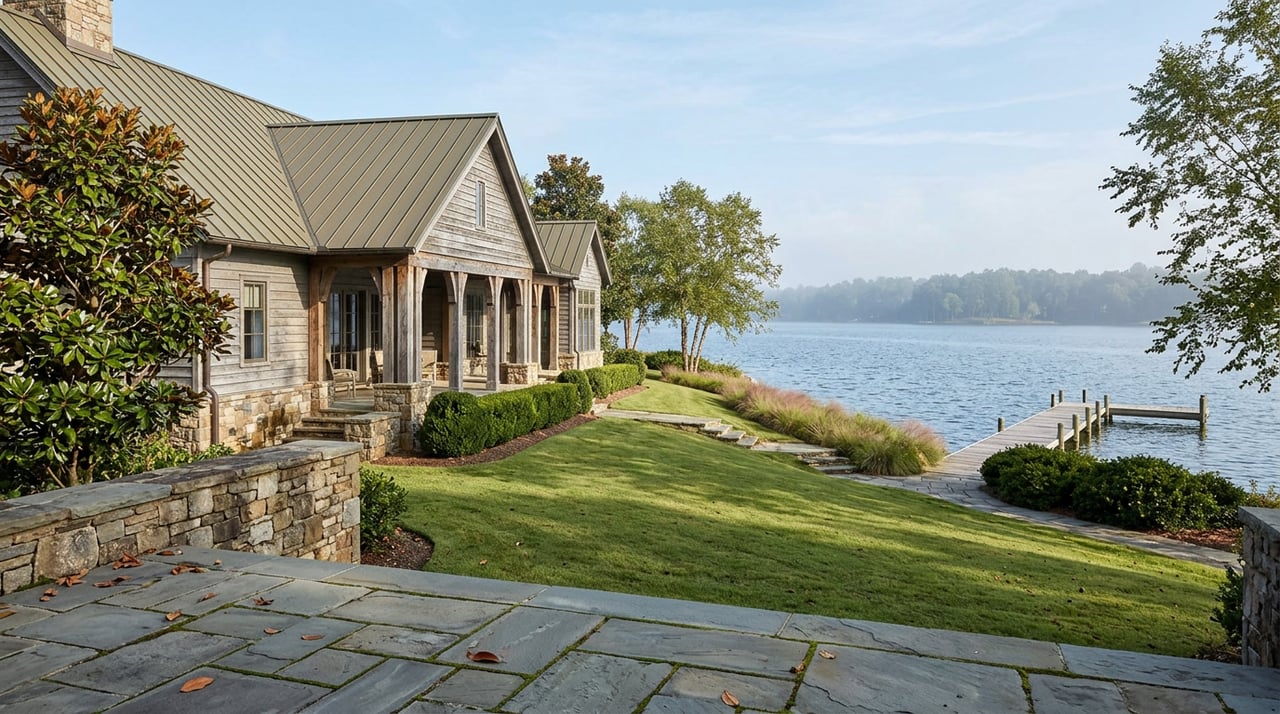
Buying a lakefront home on Lake Oconee involves more than choosing the best view.
Water depth, dock size, boat lifts, shoreline boundaries and the type of boat or Jet Skis you plan to use can all affect whether a property truly works for you.
Lake Oconee’s normal daily fluctuation is approximately 1.5 feet. That is not a significant change for most properties and generally will not interfere with normal lake activities. However, the amount of usable water at an individual dock can vary significantly from one property to another.
That is why two homes with equally beautiful lake views can offer very different experiences when it comes to boating, swimming and everyday lake access.
Before buying a lakefront property, it is important to understand what you are purchasing both inside the home and along the shoreline.
A Little Lake Oconee History
Lake Oconee is a man made reservoir created in 1979 when Georgia Power completed Wallace Dam along the Oconee River.
Lake Oconee serves as the upper reservoir in a pumped storage system with Lake Sinclair, which is located downstream. During periods of higher electricity demand, water can be released from Lake Oconee through Wallace Dam to generate power. During periods of lower demand, water can be pumped back from Lake Sinclair into Lake Oconee.
Federal records describe Lake Oconee as normally operating between elevations of approximately 435 feet and 433.5 feet. This creates an average daily fluctuation of only about 1.5 feet, which is not considered a drastic change.
Lake Oconee is known for maintaining relatively consistent water levels. That stability is one of the features buyers appreciate, especially when comparing Lake Oconee with lakes that experience much larger seasonal fluctuations or scheduled drawdowns.
The lake’s normal daily movement is part of the way it was designed to operate. Weather, rainfall, inflows and Georgia Power’s operating needs can still affect lake conditions, but the typical daily change is relatively small, 1.5 feet.
Buyers can check the current Lake Oconee water level through Georgia Power.
Why Water Depth Still Matters
A daily fluctuation of approximately 1.5 feet is not significant for most Lake Oconee properties, and it generally will not interfere with normal boating and lake activities.
However, the actual depth of the water beneath the dock is different at every property.
A dock located in deeper water may provide excellent boat access throughout the lake’s normal operating range. A dock in a shallower cove may have less clearance for a larger boat or boat lift.
The important question is not simply whether a property is lakefront. It is whether the water depth works for the way you plan to use the lake.
Buyers should consider:
• The water depth at the end of the dock
• The water depth inside the boat slip
• The type and size of boat they own or plan to purchase
• Whether they plan to have Jet Skis or other personal watercraft
• The amount of clearance required for the boat lift
• Whether the dock is located on open water, in a protected cove or along a narrower channel
• Whether sedimentation has affected the water surrounding the dock
A buyer planning to keep a larger boat at home may have very different requirements from someone who plans to use a smaller boat, Jet Skis or marina storage.
Lakefront Properties Are Not All the Same
Lakefront homes are available throughout Lake Oconee.
Within Reynolds Lake Oconee, buyers may find lakefront homes on the main Reynolds peninsula, in Great Waters or in The Landing. Other lakefront options include Cuscowilla, Harbor Club and neighborhoods located throughout Greensboro and Eatonton.
Each property needs to be evaluated individually.
Some homes offer wide main lake views and deeper water. Others are located in protected coves that may feel quieter and experience less boat traffic. Some properties have a short, level walk to the dock, while others have steeper terrain or longer pathways to the shoreline.
There is not one type of lakefront property that is right for everyone.
The best choice depends on the view you want, the boat or personal watercraft you plan to use, how often you will be on the water and the lifestyle you are hoping to create at Lake Oconee.
Understanding the Existing Dock
A dock can be one of the most valuable and important features of a Lake Oconee property.
However, buyers should not assume that every existing dock can be expanded, replaced or redesigned.
You may see the phrase “max dock” in Lake Oconee property descriptions. This generally refers to a dock constructed to the maximum dimensions approved for that particular property.
It does not mean that every lakefront lot automatically qualifies for the same dock.
Georgia Power’s current Lake Oconee guidelines consider shoreline width, property boundaries, dock dimensions, placement and the distance a structure extends into the lake. Each dock and any future modifications must be evaluated and approved for the individual property.
Georgia Power may permit up to two boat lifts on a single private residential dock. Depending on the dock configuration and approval, personal watercraft lifts may also be allowed within the approved structure.
This does not mean that every existing dock can accommodate two boats and multiple Jet Skis. The available space, shoreline measurements, property lines and existing permits all matter.
Buyers should ask for available documentation related to:
• The existing dock permit
• Boat slip, boat lift and personal watercraft lift permits
• Seawall permits
• Repairs, additions or alterations made to the dock
• Electrical work serving the dock and lifts
• The age and condition of the dock, lifts and seawall
• Any previous Georgia Power correspondence involving the shoreline
A dock inspection may also be appropriate, particularly when the dock, boat lifts or seawall represent a significant part of the property’s value.
Understanding the Georgia Power Shoreline Boundary
One of the most important things Lake Oconee buyers need to understand is that their deeded property may not extend all the way to the water.
Georgia Power owns or controls certain land within the project boundary surrounding the lake. The location of that boundary varies from one property to another.
On some properties, buyers may see yellow markings on trees or other boundary indicators. Those markings may be helpful, but they should not replace the property survey, shoreline agreement or confirmation from the appropriate Georgia Power representative.
The exact boundary matters because improvements on Georgia Power property or within the project boundary are subject to Georgia Power’s shoreline rules.
This can affect more than the dock.
Georgia Power’s current Lake Oconee guidelines address:
• Docks and boat slips
• Boat lifts and personal watercraft lifts
• Seawalls
• Dredging
• Tree removal
• Landscaping
• Walkways and sitting areas
• Fences
• Lighting
• Irrigation pumps
• Pools and other permanent structures
Pools are not permitted on Georgia Power property within the project boundary. Permanent fire pits and permanent hardscape sitting areas are also not permitted there.
A fire ring or portable fire pit may be allowed as part of an approved natural sitting area, but Georgia Power permission and the individual property conditions must be considered.
This boundary is particularly important for buyers who hope to add a pool, create a lakeside fire pit, change the landscaping or build another outdoor improvement after purchasing the home.
I help buyers identify these questions early and walk them through connecting with the appropriate surveyors, inspectors, contractors, community representatives and Georgia Power professionals before they make decisions based on an improvement that may not be permitted.
Shoreline Agreements, Permits and Fees
Georgia Power manages activity on its property and within the Lake Oconee project boundary.
A Georgia Power permit is required before beginning work within that area. This can include work involving docks, boat slips, boat lifts, seawalls, dredging, tree removal and other shoreline improvements.
Depending on the project, county, state, community or other governmental approvals may also be required.
Georgia Power states that construction permits do not currently have an application fee. However, lakefront owners may be required to maintain a legal shoreline or user agreement with Georgia Power, and fees associated with those agreements can vary based on the lake and the ownership rights affecting the property.
Before closing, buyers should verify:
• That a current Georgia Power shoreline or user agreement exists
• Whether that agreement must be transferred, updated or replaced for the new owner
• That all associated fees are current
• That the existing shoreline structures were properly permitted
• Whether there are any existing violations or unresolved issues
• Whether the buyer’s future plans would be considered under current guidelines
I walk my buyers through gathering the available documentation and identifying the appropriate people to contact so these questions can be addressed before closing.
Using Lake Water for Irrigation
Some Lake Oconee homeowners use lake water to irrigate their landscaping.
Georgia Power’s current guidelines allow irrigation pumps for qualifying single family lakefront homes directly adjacent to Georgia Power property. The pump must be located on land, cannot exceed the current horsepower limitation and must be properly installed and wired by a licensed electrician.
The presence of an irrigation system should still be verified for the individual property.
Buyers should determine whether the home has an existing lake irrigation system, whether it was properly installed and whether it meets the current Georgia Power and community requirements.
This can be a valuable feature for a lakefront property, but it is another item that should be understood before assuming it is included or can easily be added later.
Planning Future Shoreline Improvements
If you are purchasing a property with plans to add a boat lift, accommodate Jet Skis, replace a dock, repair a seawall, remove shoreline trees, install irrigation or complete dredging, those plans should be investigated before closing.
Do not assume that an improvement will be approved simply because a neighboring property has something similar.
A neighboring structure may have been approved under earlier guidelines, or the two properties may have different shoreline measurements, boundaries and conditions.
Boathouses are an especially important example.
Georgia Power’s current Lake Oconee guidelines state that boathouses are not permitted except for qualifying original property owners or their heirs who continue to own the property.
Some existing boathouses may have been previously authorized. However, the presence of an existing boathouse does not mean that a future buyer can replace, expand or substantially renovate it.
Georgia Power’s current guidelines state that previously permitted structures that no longer conform to current requirements may generally receive minor repairs. More extensive work may require additional review and could require the structure to be brought into compliance with current guidelines.
These questions need to be addressed before purchasing a property based on plans for a future boathouse or major shoreline renovation.
If a future improvement is important to your purchase, I will help you identify the questions, collect the available information and walk you through connecting with the appropriate professionals. In a shoreline matter, that may include Georgia Power, a surveyor, dock inspector, electrician, contractor, community association or county office.
That guidance is part of my job as your real estate agent.
Boat Lifts and Jet Ski Storage
A boat lift should be evaluated based on more than whether it is already attached to the dock.
Buyers should determine:
• Whether the lift was properly permitted
• The lift’s weight capacity
• Whether it can accommodate the buyer’s current or future boat
• Whether the lift operates correctly
• Whether the water is deep enough for the boat and lift
• Whether repairs or replacement parts are needed
• Whether the electrical components were properly installed and maintained
• Whether the dock has approved space for Jet Skis or personal watercraft lifts
A lift designed for one boat may not safely accommodate another.
If you plan to have a pontoon, wake boat, fishing boat or multiple Jet Skis, I want to understand that at the beginning of your search. It helps us evaluate whether an existing dock works for you or whether additional investigation is needed.
Questions I Walk Buyers Through
Before purchasing a Lake Oconee lakefront home, these are some of the questions I help buyers consider:
• What is the water depth at the dock?
• Does the water depth work for the boat I own or plan to purchase?
• Do I plan to have a boat, multiple boats, Jet Skis or other personal watercraft?
• Are the dock, boat lifts, personal watercraft lifts and seawall properly permitted?
• Is the Georgia Power shoreline or user agreement current?
• Are all associated fees paid?
• Have any shoreline structures been modified or repaired?
• Are there known erosion, shoreline or sedimentation concerns?
• What is the age and condition of the dock, lifts and seawall?
• Where is the Georgia Power project boundary on this specific property?
• Will that boundary affect plans for a pool, landscaping, fire pit or other outdoor improvements?
• Can the improvements I am considering be permitted on this property?
• Are additional community, county or state approvals required?
These questions do not mean there is a problem with the property. They are simply part of careful lakefront due diligence.
Who Handles Lake Oconee Shoreline Questions?
Georgia Power’s East Georgia Lakes Resources Office handles shoreline matters for Lake Oconee and Lake Sinclair.
The office is located at:
125 Wallace Dam Road NE
Eatonton, Georgia 31024
706 484 7500
Office hours are Monday through Friday from 8 a.m. to 5 p.m. by appointment.
Current requirements, applications and guidelines are available through Georgia Power’s shoreline management information.
Georgia Power guidelines, agreement fees, contact information, community requirements and property conditions can change.
I walk my clients through confirming the current details with the appropriate individuals. Depending on the question, that may be Georgia Power, a community or membership office, a county representative, a surveyor, an inspector, an attorney or another qualified professional.
You are not left to figure out that process alone.
Why Local Lakefront Experience Matters
When I bought my own homesite on Lake Oconee and later built my home, I learned that the questions that matter most are not always the obvious ones.
The view is important, but so is understanding how you will use the water, where you will keep your boat and whether the shoreline works for the life you are planning.
That is especially important for buyers relocating from outside the area, where lake levels, dock rules, shoreline requirements and community structures may be completely different.
Working with a real estate agent who lives in the lake community and understands the questions to ask can help you make a more informed decision.
My role is not simply to show you houses. I am here to walk you through the process, help you understand what needs to be investigated and connect you with the appropriate people along the way.
Finding the right home is only part of the move. Finding the community, lifestyle and place where you feel you belong is what makes Lake Oconee feel like home.
If you are considering a lakefront property and want help comparing communities, water access, docks and the overall lifestyle, I would be glad to walk you through the process.
Contact Charlotte Hildreth Real Estate to plan your Lake Oconee visit.
This article is general information, not legal, tax or financial advice. Consult a qualified professional about your situation.